# Uni-Lab-OS
[English](README.md) | **中文**
[](https://github.com/deepmodeling/Uni-Lab-OS/stargazers)
[](https://github.com/deepmodeling/Uni-Lab-OS/network/members)
[](https://github.com/deepmodeling/Uni-Lab-OS/issues)
[](https://github.com/deepmodeling/Uni-Lab-OS/blob/main/LICENSE)
Uni-Lab-OS 是一个用于实验室自动化的综合平台,旨在连接和控制各种实验设备,实现实验流程的自动化和标准化。
## 核心特点
- 多设备集成管理
- 自动化实验流程
- 云端连接能力
- 灵活的配置系统
- 支持多种实验协议
## 文档
详细文档可在以下位置找到:
- [在线文档](https://deepmodeling.github.io/Uni-Lab-OS/)
## 快速开始
### 1. 配置 Conda 环境
Uni-Lab-OS 建议使用 `mamba` 管理环境。根据您的需求选择合适的安装包:
| 安装包 | 适用场景 | 包含内容 |
|--------|----------|----------|
| `unilabos` | **推荐大多数用户** | 完整安装包,开箱即用 |
| `unilabos-env` | 开发者(可编辑安装) | 仅环境依赖,通过 pip 安装 unilabos |
| `unilabos-full` | 仿真/可视化 | unilabos + ROS2 桌面版 + Gazebo + MoveIt |
```bash
# 创建新环境
mamba create -n unilab python=3.11.14
mamba activate unilab
# 方案 A:标准安装(推荐大多数用户)
mamba install uni-lab::unilabos -c robostack-staging -c conda-forge
# 方案 B:开发者环境(可编辑模式开发)
mamba install uni-lab::unilabos-env -c robostack-staging -c conda-forge
# 然后安装 unilabos 和依赖:
git clone https://github.com/deepmodeling/Uni-Lab-OS.git && cd Uni-Lab-OS
pip install -e .
uv pip install -r unilabos/utils/requirements.txt
# 方案 C:完整安装(仿真/可视化)
mamba install uni-lab::unilabos-full -c robostack-staging -c conda-forge
```
**如何选择?**
- **unilabos**:标准安装,适用于生产部署和日常使用(推荐)
- **unilabos-env**:开发者使用,支持 `pip install -e .` 可编辑模式,可修改源代码
- **unilabos-full**:需要仿真(Gazebo)、可视化(rviz2)或 Jupyter Notebook
### 2. 克隆仓库(可选,供开发者使用)
```bash
# 克隆仓库(仅开发或查看示例时需要)
git clone https://github.com/deepmodeling/Uni-Lab-OS.git
cd Uni-Lab-OS
```
3. 启动 Uni-Lab 系统
请见[文档-启动样例](https://deepmodeling.github.io/Uni-Lab-OS/boot_examples/index.html)
4. 最佳实践
请见[最佳实践指南](https://deepmodeling.github.io/Uni-Lab-OS/user_guide/best_practice.html)
## 消息格式
Uni-Lab-OS 使用预构建的 `unilabos_msgs` 进行系统通信。您可以在 [GitHub Releases](https://github.com/deepmodeling/Uni-Lab-OS/releases) 页面找到已构建的版本。
## 引用
如果您在学术研究中使用 [Uni-Lab-OS](https://arxiv.org/abs/2512.21766),请引用:
```bibtex
@article{gao2025unilabos,
title = {UniLabOS: An AI-Native Operating System for Autonomous Laboratories},
doi = {10.48550/arXiv.2512.21766},
publisher = {arXiv},
author = {Gao, Jing and Chang, Junhan and Que, Haohui and Xiong, Yanfei and
Zhang, Shixiang and Qi, Xianwei and Liu, Zhen and Wang, Jun-Jie and
Ding, Qianjun and Li, Xinyu and Pan, Ziwei and Xie, Qiming and
Yan, Zhuang and Yan, Junchi and Zhang, Linfeng},
year = {2025}
}
```
## 许可证
本项目采用双许可证结构:
- **主框架**:GPL-3.0 - 详见 [LICENSE](LICENSE)
- **设备驱动** (`unilabos/devices/`):深势科技专有许可证
完整许可证说明请参阅 [NOTICE](NOTICE)。
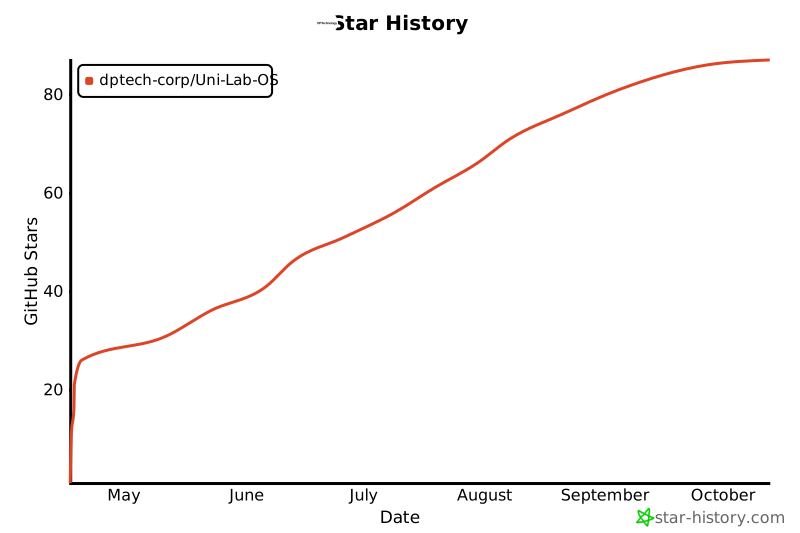
## 项目统计
### Stars 趋势
 ## 联系我们
- GitHub Issues: [https://github.com/deepmodeling/Uni-Lab-OS/issues](https://github.com/deepmodeling/Uni-Lab-OS/issues)
## 联系我们
- GitHub Issues: [https://github.com/deepmodeling/Uni-Lab-OS/issues](https://github.com/deepmodeling/Uni-Lab-OS/issues)